On Historically Informed Performances in Classical Music.

In recent years, classical performance has become obsessed with “Historically Informed Performance.” To me, this is partly a result of the lack of relevance that classical musicians often feel they have nowadays. It is no longer enough to simply be a gifted and creative musician; one must also be an intellectual, a historian. It is, of course, also a way to secure subsidies: “I will do three years of state-funded research to find out exactly how Bach heard Bach, and then I will reveal this to the public” like a Robin Hood of history taking the define of the past and bringing it to our stale modern time.
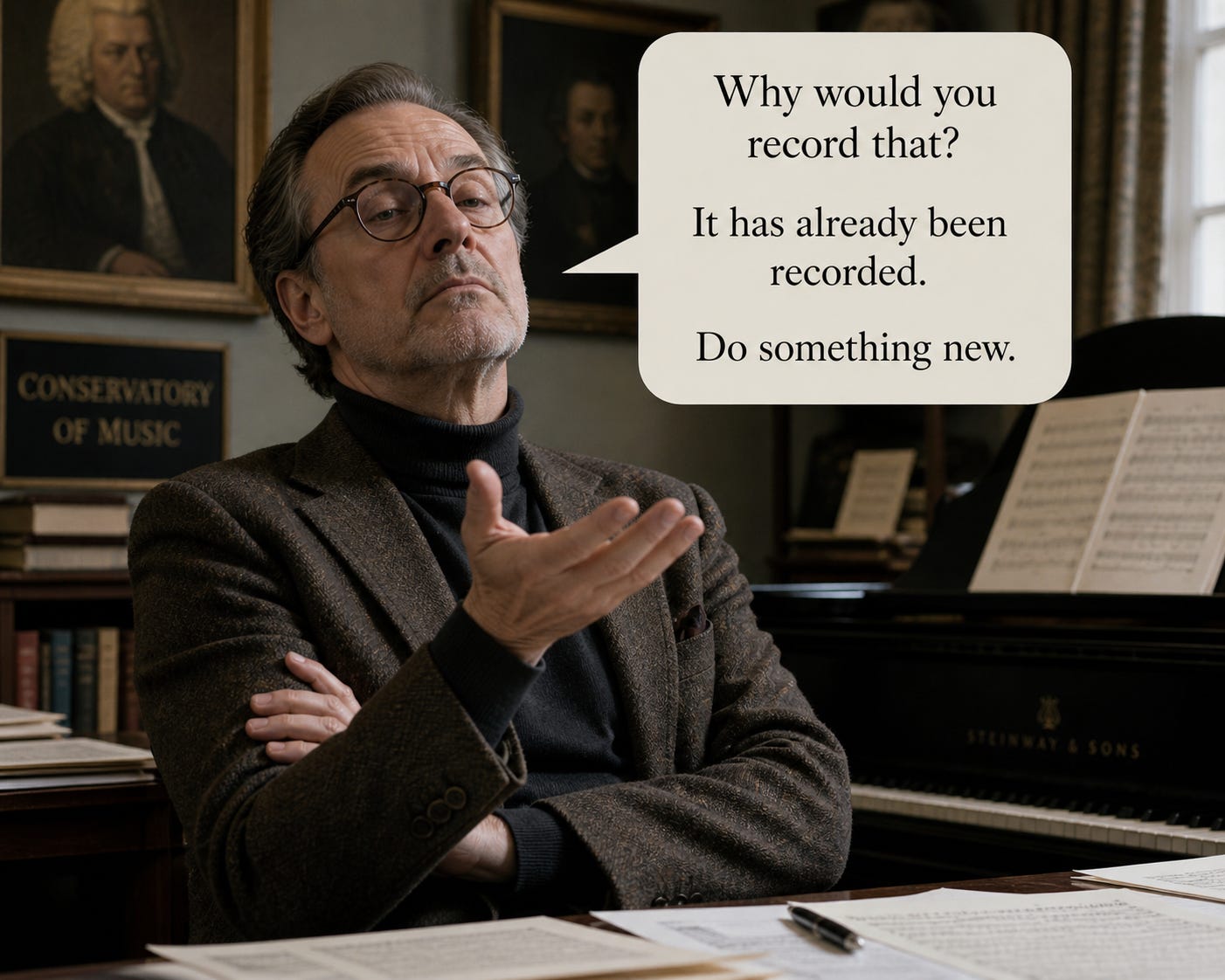
Some historically informed performances are extremely good, although the movement has become so dominant that nearly all newly recorded classical music now comes with some booklet of research on the historically informed techniques used in the recording. Along with this movement comes a new critical assessment of what should be recorded. It is very common for a conservatory teacher to react with quiet disdain and ask, “Why would you record that? It has already been recorded. Do something new,” when a student wants to record a canonical piece. By “something new,” the teacher means a piece of music of which there does not yet exist a historically informed performance. It is in these comments that we can discover a massive quest being undertaken here: a quest to record all music in a historically informed way. This is a vast undertaking, consuming a huge part of the classical industry. Maybe if they succeed, they can finally move on. On to the future. On to historically uninformed music or, in other words, music of the day and the days to come.
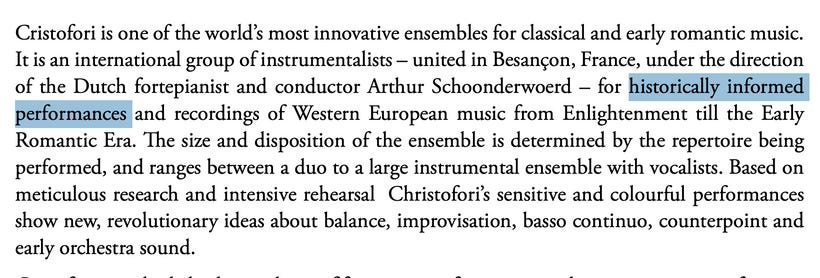
The irony with an ensemble like Cristofori is that they are extremely good musicians, but the recordings are not of such high quality. This is why they call it historically informed performance, not historically informed recording. This has been done in the sense that people have placed microphones in the halls and seating positions where the pieces were originally played, but modern recording techniques are of such undeniably higher quality that it is preposterous not to use them. Glenn Gould was very right to never perform again and just chase the perfect recording.
